Why stereoscopic photography continues to fascinate me, and how depth can become more than a technical effect — an integral part of the photographic image.
Stereoscopic photography has fascinated me for many years, but not simply because it can make a photograph appear three-dimensional. What interests me is the way it changes how we look. Depth becomes part of the composition. The space between objects matters. Even an ordinary scene can become something quite different when we are able to experience it spatially rather than as a flat image.
Much of photography is concerned with reducing the world to two dimensions. We use perspective, light, focus and composition to suggest depth on a flat surface. Stereoscopic photography does something rather different. It allows space itself to become part of the image. For me, that opens up creative possibilities that go far beyond the novelty of simply making something “look 3D”.
I came to stereoscopic photography with a background in conventional photography, so perhaps inevitably I tend to approach it first as a photographer rather than as a 3D technician. I still think about light, composition, timing and subject, but I also have another element to work with: depth. Sometimes that means choosing a viewpoint because of the relationship between foreground and background; at other times it means discovering that a seemingly ordinary subject becomes unexpectedly compelling when seen stereoscopically.
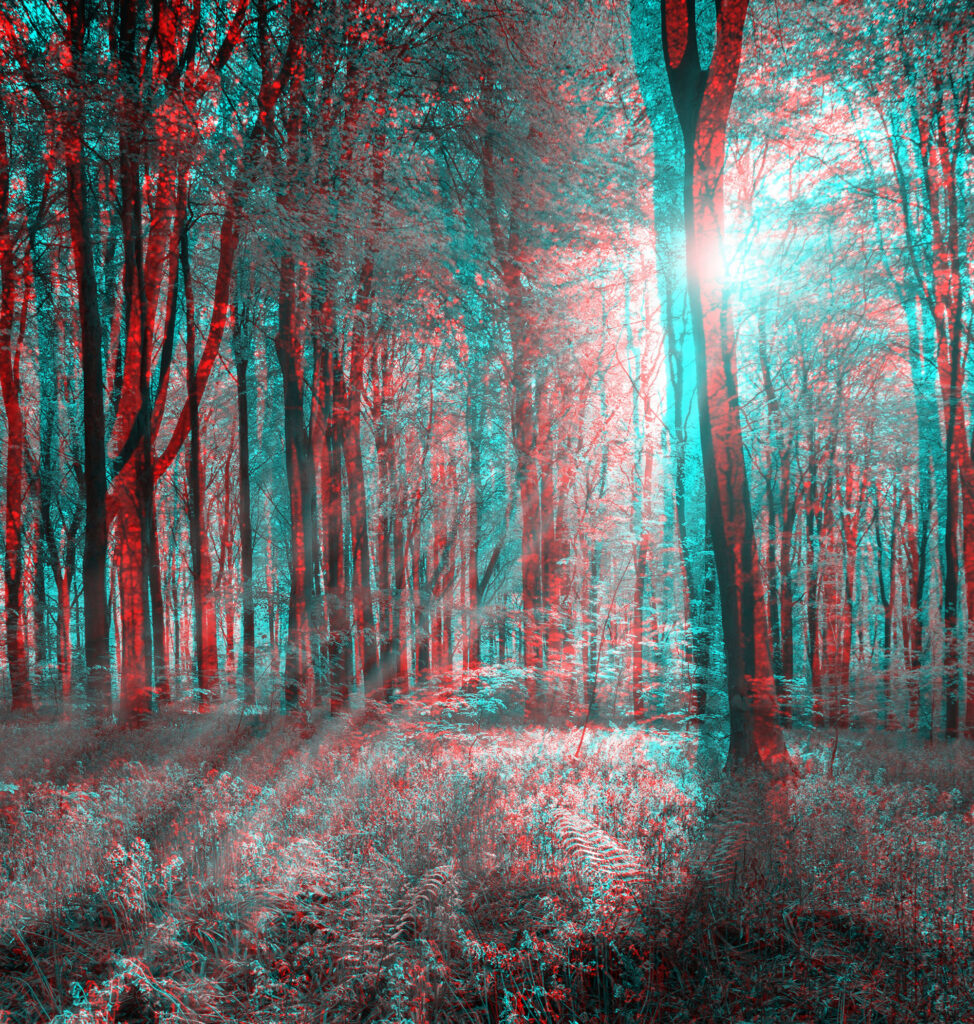
Woodland Walk — anaglyph stereoscopic photograph. Viewed with red/cyan glasses, the layers of the woodland open into depth.
What continues to interest me is not simply recording the world in three dimensions, but exploring what can be done with that extra dimension creatively.
Stereo can exaggerate, conceal, reveal and occasionally unsettle.
An image can work perfectly well when viewed normally, yet offer something quite different when seen through 3D glasses. That possibility — of an image containing another experience waiting to be discovered — is something I increasingly want to explore in my work.
This Journal will follow some of those explorations: finished photographs, works in progress, experiments that succeed and occasionally those that do not. There will inevitably be some discussion of technique along the way, but principally I want it to be a record of ideas — what I am making, what I am looking at, and where stereoscopic photography might take me next.